|
Japan on My Mind by Mairéid Sullivan
Photos by Roger Hammond
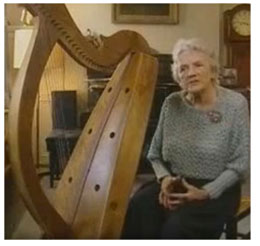
The shakuhachi is Anne Norman’s voice. She ‘sings’ the pure voice of the shakuhachi with the sense of freedom and sheer ecstasy of a gifted singer! I don't remember ever hearing any instrument play such pure voice-like tones!
The shakuhachi first came to Japan during the Nara period (710-794) from Tang China, more than 1,000 years ago. Many different approaches to playing the shakuhachi have evolved through highly refined musical styles and bear the names of the founders of respective schools.
Meian-ryu is the oldest school of shakuhachi playing and is inseparable from the original doctrine of ‘blowing Zen'. Zen-Buddhism practitioners often prefer to play the shakuhachi, rather than reading sutras, to achieve Enlightenment (satori). ‘Itton Jobutsu' - Buddha is hidden in one sound - is a saying of Fuke monks. Anne's style is natural, looking for a quality and purity of sound in each and every note.
Anne Norman recently curated a brilliantly conceived mini-exposition on Japanese culture here in Melbourne, Japan on My Mind —an adventurous program of calligraphy ‘performance’ set to music, dance, songs, spoken word and a traditional tea ceremony— a rare intimate insight into deeply cultivated artistic sensibility in Japanese culture. Read the entire article here.
Record Industry Braces for Artists’ Battles Over Song Rights
By Larry Rohter, August 15, 2011, New York Times
Excerpts
[Recording artists] have generated tens of millions of dollars for record companies. But thanks to a little-noted provision in United States copyright law, those artists ... now have the right to reclaim ownership of their recordings, potentially leaving the labels out in the cold.
...
When copyright law was revised in the mid-1970s, musicians, like creators of other works of art, were granted “termination rights,” which allow them to regain control of their work after 35 years, so long as they apply at least two years in advance....
“In terms of all those big acts you name, the recording industry has made a gazillion dollars on those masters, more than the artists have,” said Don Henley, a founder both of the Eagles and the Recording Artists Coalition, which seeks to protect performers’ legal rights. “So there’s an issue of parity here, of fairness. This is a bone of contention, and it’s going to get more contentious in the next couple of years.”
...
As the record companies see it, the master recordings belong to them in perpetuity, rather than to the artists who wrote and recorded the songs, because, the labels argue, the records are “works for hire,” compilations created not by independent performers but by musicians who are, in essence, their employees.
Independent copyright experts, however, find that argument unconvincing. Not only have recording artists traditionally paid for the making of their records themselves, with advances from the record companies that are then charged against royalties, they are also exempted from both the obligations and benefits an employee typically expects.
“This is a situation where you have to use your own common sense,” said June M. Besek, executive director of the Kernochan Center for Law, Media and the Arts at the Columbia University School of Law. “Where do they work? Do you pay Social Security for them? Do you withdraw taxes from a paycheck? Under those kinds of definitions it seems pretty clear that your standard kind of recording artist from the ’70s or ’80s is not an employee but an independent contractor.” Go to the article here.
Musician 2.0, 3.0, 4.0 ...Developing Music Careers in Uncertain Times
A Psycho-Spiritual-Musical Manifesto by Peter Spellman

If you were to judge the health of the recording industry by the mainstream press you’d have to conclude things do look pretty bleak. Industry trade groups like the RIAA and the IFPI continue parading their woeful data on global CD sales and there are no signs of improvement. In real dollars the industry has been flat-lining for nine straight years. And it’s not just the recording industry that’s ailing. Other sectors of the biz – music publishing, music products and the concert industries – are also registering declines. The key word here is “industry”. It’s important for those in the biz to make the distinction between the music “industry” and the music “trade.” The former is primarily the domain of transnational corporations and organizations like the RIAA and the major music companies; the latter the domain of most musicians and a tremendous diversity of small music enterprises, most “under the radar” and perceived by the former as basically insignificant in the larger picture. Full feature here.
Latest Features
Ry Cooder - Pull Up Some Dust and Sit Down (2011)
Musician 2.0, 3.0, 4.0 ...Developing Music Careers in Uncertain Times
A Psycho-Spiritual-Musical Manifesto by Peter Spellman
Chieftains and San Patricios
by Mairéid Sullivan
The Orchestrion Project
by Pat Metheny
Jeremy Kittel - Chasing Sparks
An interview with
Henryk Gorecki
by Norman Lebrecht
An Interview with
Buddy Guy
By Robert Loerzel
American Idol
by Paul Adams
Ry Cooder
|

Latest Reviews
Dave Preston - Soundtrack For Motion
Ancient Traditions, Future Possibilities: Rhythmic Training
through the Traditions of Africa, Bali, & India
by Matthew Montfort
Mollie O’Brien and Rich Moore - Saints and Sinners
Kim Richey ~
Chinese Boxes
Larry Sparks ~
The Last Suit You Wear
King Wilkie ~
Low Country Suite
T-Bone Burnett ~ The True False Identity
Joseph Marshall III ~
The Lakota Way
|

Time after Time, the ground-breaking, award winning film is now available on DVD.
"Rich, embracing and informative...
an exhilarating example of visual world music at its best." Don Heckman, Los Angeles Times
Click here to buy the DVD.
View YouTube Trailers
Click here for 90 second trailer.
Click here for 8 minute trailer.

A celebration of ancient Celtic, North American and Australian peoples. There is magic here as sublime poetry and ancient song celebrate freedom and echo a world beyond ours. ... The result is as moving and affecting as all great art.
|
International Standard Serial Number (ISSN)
Alternate Music Press ® is a registered publication.
Our ISSN number is ISSN 1524-6272
We welcome your comments, suggestions, requests and contributions.
The opinions expressed on this site are 100% our own.
We have no sponsors or advertisers to influence any of the content on this site,
and we are very proud of that independence.
All content copyright ©1997-2011 except where noted . All rights reserved.
Unauthorized duplication and distribution of copyrighted material violates Federal Law
. Legal Disclaimer
|

If
you are a musician, or represent a label, AMP can be a
valuable tool to help you gain wider recognition.Musicians,
publishers, distributors, and record companies wishing to send compact
discs, sample media, books, music hardware and DVD video for review consideration, please click here for further details.
Thank you for visiting.
|
This site is copyrighted ®© AMP/Alternate Music Press, 1997-2012. All Rights Reserved.
|